The Colorado State Capitol is one of the prominent features in Denver's skyline. The building is composed of Colorado rose onyx (also known as Beulah red marble), a type of stone so rare that all known reserves were used in the capitol’s construction. The Colorado rose onyx itself was quarried in the town of Beulah, Colorado.
In addition, in 1908 the capitol’s dome was plated with 200 ounces of glistening 24-karat gold leaf, to commemorate the gold rush, and the brave pioneers and miners who helped Colorado take shape. Three reapplications of the Colorado gold leaf occurred between 1908 and 1980—the newest golden shine now comes from 47.5 ounces of gold that was mined near Florence, Italy, and applied in 1991. Re-leafing the dome is an arduous task—in 1991 it took four men six months to remove the old gold and reapply the Florentine gold to the dome.
The state capitol building was constructed in the Neoclassical style, similar to the capitol building in Washington D.C., and the similarities don't stop there. The building is also surrounded by many of the streets found around our nation’s capitol. You'll find Pennsylvania Avenue located two blocks to the east, and Lincoln Avenue bisecting Civic Center Park at the capitol’s western entrance. Grant Street, along the capitol’s eastern entrance, was named in honor of President Grant, who was in his second term when the Colorado Territory officially became a state on August 1, 1876. Colfax Avenue, along the capitol's northern entrance was named for Grant's Vice President, Schuyler Colfax.
The Colorado state capitol building rests at exactly one mile above sea level. On the western entrance’s 15th step you’ll notice the inscription “One Mile Above Sea Level.” Don’t be fooled, though. This is not the true one-mile marker. The inscription was made based on measuring techniques from 1909, by students of the University of Denver. Originally, a brass cap was installed to commemorate this first measurement, but after the cap was stolen seven times in a matter of 38 years, the state carved the claim into the stone step itself. In 1969, engineering students from Colorado State University re-measured the distance and found it was slightly off. To compensate for the discrepancy, they installed a brass plaque two steps higher—however, their measurement was off as well. Finally, in 2003, college students from the Metropolitan State College of Denver re-measured the height, and in a dedication ceremony that same year, Governor Bill Owens placed the official marker on the 13th step—the true mark of one mile above sea level.
Did You Know?
The capitol's original signature dome was made of copper, but was swapped out for gold in 1908 due to the copper’s tendency to oxidize, creating a dull patina cover. Only after the gold was applied, and the light bulb within the belfry screwed in and turned on, was the capitol considered finished.
Good To Know Before You Go:
Tours of the capitol building are offered every 45 minutes. Walk-ins are welcome and happily accommodated. Reservations are required only if you are planning to tour the building with 10 or more members, are part of a senior citizen group, school, day-care center or have a disability. Signs throughout the capitol lead visitors to the tour desk.
ADA Accessibility:
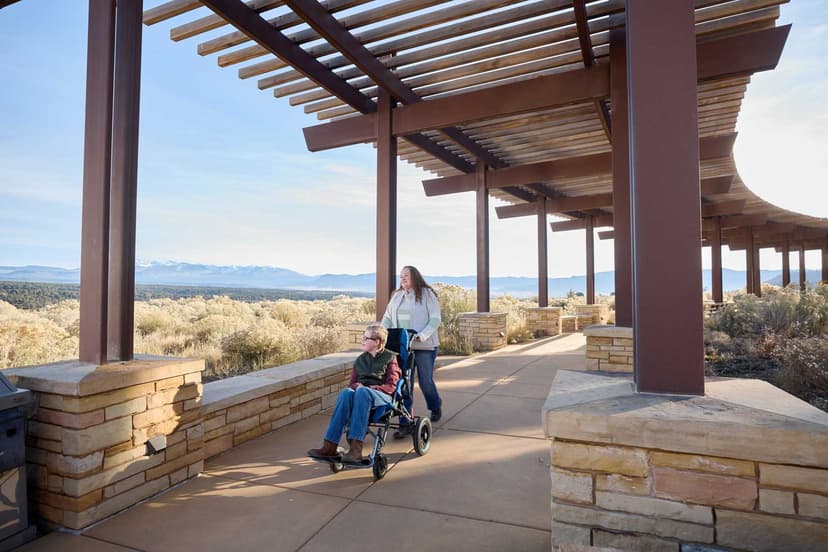
Tours are available to those with special needs, but reservations are required. Onsite handicap parking is also available.
Hours:
Tours are provided every 45 minutes.
September–May: Monday–Friday: 9:15 am–2:30 pm.
June–August: Monday–Friday: 9 am–3:30 pm.
Tours are free of charge to the public.
200 E. Colfax Ave, Denver, CO 80203-1784
www.colorado.gov
Tour Desk: (303) 866-2604
Manager of Visitor Services: (303) 866-4747
This project is partially funded by a State Historical Fund grant award from the Colorado Historical Society.
Colorado's Historic Sites
Read More >>