Quantcast

Mesa Verde National Park

The most notable feature of Mesa Verde National Park is the cliff dwellings — or ancient pueblos constructed beneath massive rock overhangs —  found skillfully wedged in the canyon walls. But they only represent a sliver of the many years of cultural history associated with the mesa in southwestern Colorado. In fact, while the Ancestral Puebloans inhabited Mesa Verde for more than 700 years, for the first six centuries they mainly lived on the mesa tops. It wasn't until the last two generations  that they constructed and lived in the cliff dwellings for which Mesa Verde is known.

DISCOVERY OF THE PARK

In 1888, a cattle rancher named Richard Wetherill and his companions were searching the southwest countryside for stray cattle when they came across a ravine that contained a magnificent group of cliff dwellings. Later, the men would name the largest site Cliff Palace. Intrigued by his find, Wetherill returned later that evening to explore more of the area. During this second venture, he came across another site he would name Spruce Tree House. Not wanting to stop there, Wetherill and his brother-in-law Charles Mason rode back to the location the next day and discovered another site, which they named Square Tower House. Within a year and a half, the Wetherill family claimed to have entered 182 cliff dwellings. These finds were widely considered a turning point in Wetherill’s life — after this discovery he set his sights on explorations of other parts of Colorado and expanded his quest into areas of Utah and New Mexico as well.

On June 29, 1906, President Theodore Roosevelt signed a law officially designating Mesa Verde a national park to "preserve the works of man." It was the first national park of its kind. Since that time, millions of visitors have entered its grounds to explore the marvels of the Ancestral Puebloan civilization.

Besides offering quite an impressive history lesson, the park also offers ample outdoor activities within its borders. Hiking, camping and scenic drives are popular activities. There are very few places in the United States where you can do all this against the backdrop of ancient manmade treasures.

OPERATING HOURS

Tours and operating hours vary by season. Be sure to check the park's website to see what's happening during your visit.

WALKING TOURS

Mesa Verde National Park offers guided tours to Cliff Palace, Balcony House, Spruce Tree House, Long House and Step House. Self-guided tours are also available to several other sites of interest within the park.

Spruce Tree House

The Ancestral Puebloans built Spruce Tree House between 1211 and 1278 AD. A foray into this site is an easy one. The same cliffs that protected the site from invaders also served to protect it from the elements. Because of this, the very well-preserved architecture is ideal for seeing the original and intact construction materials used by the Ancestral Puebloans. You can even see some of the plaster on the walls — a very fragile building element. The structure is comprised of 130 rooms and eight ceremonial subterranean chambers known as kivas. This is the only site in the park where you can enter a kiva, and thanks to its easy access, the site is a favorite among kids. Those with wheelchairs can experience part of this structure as well. The 100-foot path into the site is paved, although it does not meet grade requirements, so additional help getting into and out of the site with a wheelchair is required.

Cliff Palace

The Cliff Palace tour provides an hour-long visit that takes you through the largest cliff dwelling in the park. The site can only be explored through the ranger-guided tour. You can expect to do a bit of mild climbing and walking, as the route first descends roughly 100 feet over uneven steps and ascends a series of eight-foot ladders to access and exit the site. This is a large structure with multiple living enclaves and buildings. While you're touring, take note of the composite used to create these structures. The Ancestral Puebloans used a mixture of sandstone, mortar and wooden beams in the construction of these buildings.

Balcony House

While much smaller than the Cliff Palace, Balcony House offers a more intimate, behind-the-scenes look at a civilization that flourished thousands of years before European exploration of the continent began. The tour route feels a bit like a treasure hunt as you descend a staircase 100 feet into the canyon, climb a ladder ascending the cliff 32 feet, crawl through a 12-foot long tunnel, then climb 60 feet straight up on ladders and more stone steps. The trek may be a bit difficult, but it helps you gain a sense for how well Balcony House was defended. This site is different from the others in the park in a distinct way — while most of the other structures here have good southern exposure, Balcony House faces to the east, prompting archaeologists to wonder if this colder location was used only seasonally. The history of this house is well documented. The first documented white explorer to come across the site was S.E. Osborn in March 1884. His carvings in one of the rooms, and his report in a newspaper article about the site, help document Balcony House's rediscovery.

Long House

Like the other ranger-guided tours, the Long House tour can be mildly strenuous, as it descends 100 feet into the park’s second largest structure. This one-and-a-half--hour tour provides views unsurpassed by many other archeological sites. Sandstone cliffs partially encase these ancient structures like protecting sentinels. The site itself is part of the Wetherill Mesa Archeological Project and is set a bit aside from the other sites, making it less crowded than other dwellings. A tram offered from a parking lot to the mesa accesses the Wetherill Mesa Archeological Project site. Once at Long House, a climb behind the dwelling is provided that gives you a rare look at a seep spring — a source of water emerging from the cliff and used by the previous residents. In addition to Long House, the Wetherill Mesa offers 15 distinct and excavated sites.

Step House

A very short distance from Long House sits Step House, a site unique in that its occupation by two different civilizations roughly 800 years apart can be seen. Both Modified Basketmakers (the first settlers of the area) and Classic Puebloans (the people who built the cliff dwellings) called this structure home. Look to the canyon wall for the steps carved into the rock face once used by the Ancestral Puebloans to gain access to this refuge. This self-guided tour takes you along a steeply graded three-quarter mile trail and through a structure abutting a sandstone cliff wall with a 100-foot overhang. With evergreens surrounding the area and lichens and moss coloring the abutting cliff, natural beauty is everywhere along the hike.

DRIVING TOURS

Scenic drives also provide unique looks into the history of the mesa. The national park has three driving tours that showcase as much beauty as they do historic relevance: Mesa Top Loop Road, Museum Loop Road and the Cliff Palace Loop Road.

Mesa Top Loop Road

This drive takes you through a visible timeline, as seen through the progression of architecture. The one-and-a-half-hour drive takes visitors on a self-guided odyssey through a 600-year history of surface sites, with a spectacular overlook providing views of cliff dwellings.

Museum Loop

The Museum Loop takes visitors from the Chapin Mesa Museum — with informative videos about the area’s history and interactive exhibits, dioramas and artifacts — to the Spruce Tree house, where a self-guided tour is available. For more opportunities to hike around the area, the Petroglyph Point Trail provides a 2.8-mile hiking trail displaying rock art. A guidebook to this trail is available at the museum. Round off this loop with a stop for lunch at the picnic area where more than 30 picnic tables await.

Cliff Palace Loop Road

From the Cliff Palace Overlook, you can view the largest cliff dwelling in North America. Balcony House is also along this route and is open to ticketed, ranger-guided group and school tours. This drive also provides access to the Soda Canyon Overlook Trail. The short, 1.5-mile hike, offers the only view of Balcony House without a tour.

ADA ACCESSIBILITY

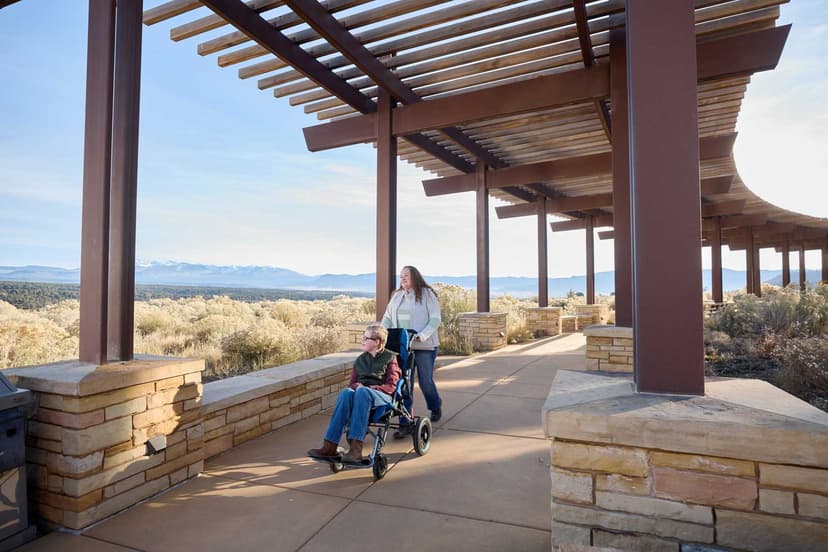
The majority of ranger-guided tours are not ADA accessible. However, a tour of Spruce Tree house may be completed with minimal assistance. Scenic drives through the park are also available. The visitor centers are accessible to those with disabilities, but it is best to call ahead for access to other areas.

COLORADO'S HISTORIC SITES

Read More >>

This project is partially funded by a State Historical Fund grant award from the Colorado Historical Society.


The Official Site of Colorado Tourism
©2012 Colorado Tourism Office. All rights reserved.