Colorado Travel Q & A with Medical Expert Dr. Payal Kohli
CTO:
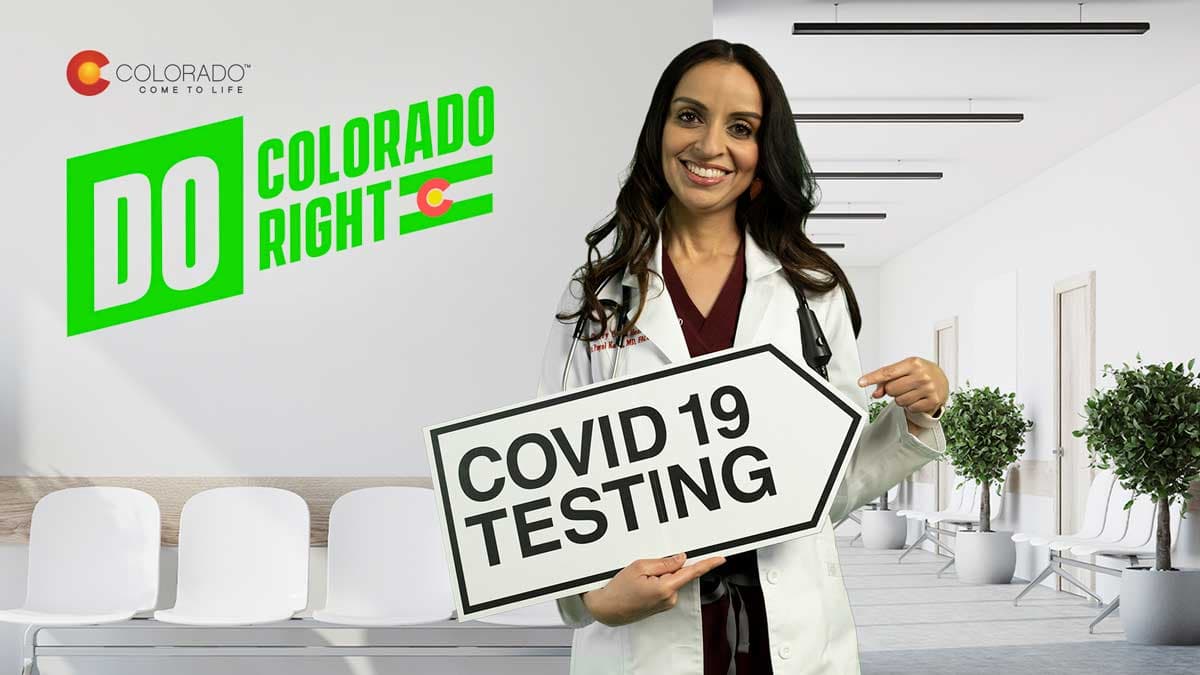
The Colorado Tourism Office is encouraging folks to educate themselves when they are traveling in and around Colorado this winter season. A great supporter of the Do Colorado Right educational campaign is Dr. Kohli. She’s going to answer some COVID-19 questions related to travel, give us the lay of the land on what’s happening in Colorado as well as what we can expect in the months to come.
It can be so difficult to keep up with all the information coming out about the ways to protect yourself but others as well. We’ve seen those consistent recommendations like washing your hands, wearing a mask, keeping distance between yourself and others. I saw yesterday that the CDC is now recommending wearing two masks when you can. Is that right?
Dr. Kohli:
That’s right. So, yeah, we’ve all kind of gotten what I call “COVID 101.” We know how to do basic things that we know work. Now is the time — because the virus got a little smarter, it mutated, got more aggressive and more contagious — that we need to get a little smarter with some of these measures and really get into “COVID 201.”
The bottom line is one mask is better than none. But if you wear just one mask, according to this new CDC study that just came out, it seems to reduce aerosol droplet transmission by about 42 percent. Now if you wear, on top of your surgical mask, a second-layer cloth mask, it actually takes that number to 82 percent.
And if both people are wearing two layers — a surgical mask with a cloth mask on top of it — that number goes to 96 percent reduction in aerosol droplets transmission.
I think this is really great because, as the virus is getting smarter, so are we. We’re able to modify our mask technique to really reduce the droplet transmission.
People ask, “Is it the layers that matter or is it the fit?” And, actually, it’s more the fit. The reason that the cloth mask on top of the surgical mask helps is because it really prevents and minimizes those air leaks that tend to happen around your nose and your chin and the sides of the mask. So, if you have something kind of plastering the mask to your face, it minimizes those air leaks.
The other type of mask-modification technique that the CDC studied is to actually tie knots in the ear loops. By tying knots right near the edges on both sides, I have actually changed my mask from a flat, two-dimensional to a more three-dimensional shape that’s probably going to conform to my face better and give me better protection underneath my chin and minimize the chance of air leaks around the side as well ‘cause I can tuck in that little bit of fabric that is sticking out and really create a barrier right around my mouth and nose.
CTO:
Is it safe to fly if you’ve been vaccinated?
Dr. Kohli:
That’s a great question, and the short answer is yes, but just remember you have to wait at least two weeks after your last dose of your vaccine. So, if it’s a two-dose vaccine — the Moderna and the Pfizer vaccine are both two-dose regimens — you have to wait two weeks after that last dose for your body to really build up those antibodies.
CTO:
What are some safe tips for flying?
Now one thing I will caution against is travel around major holidays. That’s when everybody travels, so that is not what I would recommend. Thanksgiving, Christmas, Memorial Day Weekend: These are not the times to travel because you’re really going to increase your risk at an exponential level by traveling when everybody else does. If you decide to take that family vacation, I would recommend taking a random week or a weekday or something like that when more people are less likely to travel just to minimize your risk of exposure.
And of course, even then, when you’re flying, I would recommend exercising the same precautions when flying: wearing masks, washing your hands, sitting in the window seat rather than the aisle because there’s less traffic, getting on the plane last because it’s less likely that you’ll be sitting there as long and less likely that people will be walking past you. Try to keep your mask on when you’re sitting on the plane, so try to eat and drink when you’re in the airport instead of when you’re in the airplane, which is a smaller environment.
I read somewhere that covering your eyes — wearing glasses or an eye-protection shield — does protect you because there have been several case reports of people contracting coronavirus through the eyes on an airplane.
CTO:
How do you protect yourself in an airport and on public transportation?
Dr. Kohli:
So, when you leave your house, you’re going to leave your house using a taxi or an Uber, right? And so the most important thing in that situation is to make sure both parties are masked. In fact, as we just said a few minutes ago, maybe several masks to improve your protection. If the weather allows, it would be nice to roll down your windows and let some of that fresh air into the car so you’re not both breathing each other’s air or droplets.
Make sure nobody handles your luggage. Put it in the trunk yourself, take it out yourself ‘cause the handle is a high touchpoint and you want to make sure you’re the only one whose germs are on it. When you get it back from the baggage-claim people, make sure to wipe it down nicely because, again, when you touch that and then touch your face you can increase the risk of transmission.
And then if I get into an Uber or something, I make sure to have some alcohol wipes on me and really wipe down the handles — the window handles, the seatbelt handle; anything that you’re touching or that’s touching you, you should really wipe down.
And I know this is hard for some of us and for some of the drivers; but try to keep the conversation at a minimum because, the more you’re talking or on the phone, the more you’re generating droplets — and the more risk there is for spreading in an enclosed space.
If you’re going to take public transportation, it’s a little bit of a bigger space, whether it’s a train or a bus, so that makes it a little safer; but there are more people in it obviously. So, again, try to keep as much distance from other people as you can and try to keep your masks on the whole time. Don’t take it off to put on your makeup, don’t take it off to take a drink of water. Wait until you get outside so that you’re minimizing your exposure.
And then once you get to the airport, it’s actually interesting because they say the plane is slightly safer than the airport itself because the plane is being filtered — every four to six minutes they put a whole bunch of fresh air into the plane; and there’s HEPA filters on the plane that are small enough for those virus particle sizes. The plane itself is a reasonably safe environment.
Where you have to worry at the airport is where people congregate. We’re talking about the TSA security line, baggage claim, where you go to buy your dinner and getting in line for pizza, the restrooms. So that’s where you kind of have your guard up — anywhere people are gathering and there’s a bunch of people standing. Because somebody else could be doing something wrong and could increase your risk of exposure.
CTO:
We all know folks that will rent a vacation home and meet up with a couple friends for a ski trip, for example. What happens if you do this and a guest you’re sharing a room with gets COVID?
Dr. Kohli:
That’s a really tough one because if you are vacationing with somebody who has COVID, you really, really have to protect yourself because sharing a room with that person, honestly, is a little bit of a setup. It really increases the probability of you getting sick. So, in that case, even though it can be expensive and challenging, I would strongly recommend you get a separate room. That person really needs to quarantine alone and make sure that they’re not coming into contact with anyone else and isolate completely. Because the risk, of course, is they would spread it to you as well. And then if both of you are contagious then that’s certainly not a desirable situation.
Be sure to be there for them — deliver food to them, those types of things, since they won’t be able to leave until they’re feeling better.
CTO:
What’s the best way to ensure your kids are kept safe when you’re on the road?
Dr. Kohli:
The good thing is that kids under 10 don’t seem to be at high risk for the virus — both for catching it and for spreading it — as kids over the age of 10. Part of it could be habit, part of it could be changes in their immune systems, but it is important as a parent to keep your child safe.
If your child is above the age of two, you’re certainly going to need a face covering for them. I think hand hygiene is one of the most challenging things when it comes to our children, especially when we’re traveling. So, you have to be really, really mindful that you’re sanitizing often and that they’re washing their hands.
The parents have to be the eyes and the ears, making sure the mask is working correctly, it’s on their nose and mouth; make sure their hands are clean, and make sure if they’re using public restrooms or anything like that that you’re really mindful of what they’re touching.
And then for the older kids, I think when you’re traveling with them, it’s more about teaching them and reminding them gently, especially the adolescents, about limiting contact. Try to consolidate trips into one.
Some kids have had trouble tolerating the face mask and there’s some data, as well, that in young kids you can actually substitute a face shield for the mask because that allows the child to breathe a little bit better. It still offers protection to them as well as the people around them because they’re lower risk for spreading it.
CTO:
We carry around our hand sanitizer everywhere, but how concerned should we be about the cleanliness of surfaces while we’re traveling?
Dr. Kohli:
The primary mode of transmission, as we talked about, is through droplets or through aerosol transmission through the air. But a secondary mode of transmission is through surfaces.
Everything is contaminated unless proven otherwise. And when you’re traveling, it’s a really good idea to have those alcohol wipes with 70 percent isopropyl alcohol. If you’re to be, for example, sitting on your plane seat, I’d wipe down the tray table, the headrest because my face and my mouth goes next to it, I’d wipe down the armrest and the handle on the window. Similarly, when I’m going to restroom, I make sure I don’t touch anything without having a barrier of protection — a tissue or a paper towel — and open and close the handle with that.
Those types of precautions are actually really important because a lot of people who are not living with somebody who’s sick have ended up getting sick; and we’re realizing more and more that this mode of transmission may play a bigger role than we initially thought.
CTO:
Let’s talk about some activities to do while you’re traveling that are on the lower-risk side of the equation.
Dr. Kohli:
When I’m trying to decide what I want to do on my vacation, I try to ask myself three questions. Who is going? Where are they going? And how are they going?
Are you going with people that are in your immediate household, which is the lowest risk? Or are you meeting up with friends from all over the country, which is really considered the highest risk because people are coming from different places and have had different contacts? If you’re going to have friends meeting you, then try to minimize the risk by testing beforehand and potentially even testing after the exposure to really minimize the chance that one of them might have brought the virus into your group.
Where are you going? Go to state like ours that has a relatively good positivity below 5 percent, and the virus rates are low in the community. It’s also important where you’re coming from. Both of those really factor into the risk of the vacation.
If you’ve got one person in your vacation party coming from a hot state and everyone else coming from nice, well-controlled states, that hot-state person could potentially increase risk to your party.
And then how are you going? You can fly, you can drive, you can take the train. We talk about the safest being a road trip with your immediate family.
Try to pick an activity that’s outdoors. Try to go where the cases are low in the community, so try to go to a county or part of the state where there’s not a lot of virus activity going on.
Try to pick activities that don’t spread a lot of droplets. So being inside a bar cheering on the big game is going to spread a lot of droplets; but if you’re outside hiking and you’re all a good distance apart, you’re having physical activity — but there’s so much fresh air, it really doesn’t have that same sort of impact.
CTO:
When we look at planning ahead, with some destinations asking for you to have a negative test before you arrive, is it better to take it when you get to your destination or take it before you leave?
Dr. Kohli:
There’s two ways to think about this. If you’re going somewhere that requires you to take a test before, then you are stuck — you have to take it before. The recommendation is about 48 hours before, and then don’t do anything in those 48 hours. Don’t go to CVS, don’t have a party, don’t have people over because that resets the clock on the exposure.
Ideally, I would say the safer thing to do is to take the test after you arrive because that already incorporates that exposure that you may have had while traveling. Keep in mind that you can’t walk off the plane and test because it’s not going to reflect that exposure you just had — it takes three to five days for the virus to build up inside your body after you catch it in order for that test to turn positive.
After you arrive, wait three to five days, get tested, and then come out of quarantine in order to mingle with other people.
If that’s not practical or that’s not something that you can do, then you can sandwich the tests. Take the test 48 hours before and then take it again three to five days later. Then you’ve already ruled out all the exposures before you traveled and then the exposure during the travel.
The other thing I’ve seen a lot of my colleagues and friends do if they want to travel and they want two households to mix — you self-quarantine for 14 days. You decide for 14 days, we’re not going to see anyone or do anything before we travel. Now of course the travel itself is an exposure but, again, you minimize your changes during that; and by quarantining for 14 days beforehand, you’ve really eliminated any possibility that you’re sick before you start to travel.
CTO:
What do folks need to do when dining out? What could they do to keep themselves safe, or do we just need to utilize outdoor dining options?
Dr. Kohli:
We’re lucky here in Colorado because we have so much sunshine that people can really eat outside. I also recommend trying to go at a time when the restaurant is not as busy. Picking slightly off times, like a little early or a little late for lunch, just so that there’s fewer people around.
The nice thing is that COVID does not appear to spread through food itself. So really the risk of eating at a restaurant comes from the exposure to your waiter and other customers that might be walking by, and the fact that you have your masks off when you’re eating.
All of those can combine to increase your exposure, so here’s what I do when I go out to eat. I try to get that outside table. I try to keep a bottle of sanitizer on the table and
sanitize my hands several times during the course of my meal. The other reason I have that sanitizer out is because I like to sanitize my hands and put on the mask in between courses. So even though it’s not pleasant to do, you want to minimize the time that the mask is off your face because, the more it’s off, the more your risk of having those droplets come and infect you.
Try to have as little contact as possible with the credit card, with the pen, with anything like that. So, if you have a contactless option for paying, you certainly want to think about doing that.
If you’re sitting inside, you definitely want to try to make sure that those tables are spaced far apart. You want to make sure you’re not sitting near the air conditioning or the heating cause that can actually carry droplets around the room and create wind patterns that can carry droplets. If you can sit near an open window or door, that’s obviously the most desirable.
CTO:
What if you’re on a trip and you test positive for COVID or you start feeling symptoms? Can you still engage in those outdoor activities like skiing or going for a hike or do you need to hunker down and wait it out?
Dr. Kohli:
The latter. You absolutely cannot — even if you’re outside — if you’re positive, be out and about. It’s a public safety hazard. It’s a risk to you. It’s a risk to others. So as hard as it is on vacation to get sick with something like this, just think about the fact that you may be asymptomatic or minimally symptomatic, but you getting out there may give somebody the virus that could die from it or could have a serious, life-threatening complication from it.
Please be mindful of that when you’re traveling. Of course, we’re not enforcing this in any particular way, so if you test positive, it’s not like you’re necessarily going to be called, but it falls upon us as citizens and community members to look out for each other. Like I said at the beginning, that’s the only way we’re ever going to get through this — if we’re helping each other out.
What I would urge is if you test positive, not only do you need to hunker down yourself until you’re symptom free and the 14 days have passed and maybe you test negative; you may also want to think about calling everybody — your Uber driver, whoever it is you sat next to on the plane if you have their number, any other contacts that you know of that you came into close contact with in the last three days.
It’s really those three or four days before you start having symptoms or you test positive when you’re most infectious. That’s what I would do and that’s what I tell my patients when they say they’re positive — call everybody you know you’ve seen in the last few days and let them know that you’re positive.
CTO:
How big is too big for one’s travel bubble?
Dr. Kohli:
It’s not so much the number of people, but it’s really the number of contacts with new people. So, if you have two families that have been seeing each other, they’ve been in their bubble; they’re two families of four — that’s eight people — they’ve been together all the time. That’s totally fine. That is a great travel bubble because those two families have already been interacting with each other.
On the other hand, if you have eight friends from all around the country that are meeting up at a certain location, that’s dangerous — even if it’s four friends. It’s much more dangerous than if it’s those eight people from two families.
When you’re thinking about your bubble, you don’t necessarily want to think about the number of people. You want to think about who is in it, how close are they to your current bubble and how well do know their activity patterns. Is this somebody whose activity patterns you reasonably trust?
When you’re thinking about creating your travel bubble, you want to try to keep it as small as possible. But more than the number of people, it’s really the composition of people and what they’ve been doing that’s more important.
CTO:
Along those lines, you get tested and it comes back positive. How long do you stay in your destination before it’s safe for you to travel back home?
Dr. Kohli:
This is a tough one. There are two strategies that the CDC has recommended. One is a symptom-based strategy, which is basically from the resolution of your symptoms — they have to be getting better, you have to be at least 10 days past the first day you had symptoms and you have to not have had a fever at least 48 hours off a fever-reducing medication like Tylenol and Advil. You have to hit all of those criteria to sort of know that you’re no longer infectious.
What I prefer, and what I tell my patients, is a 10-day strategy. ‘Cause there are people who we call prolonged viral shedders, meaning they’re giving off that virus for longer than you would expect. If the incubation period of the virus is about 14 days, so we really don’t think it should be in your body more than 14 days, but some people have it for weeks or even longer. I like to advise my patients that after your symptoms resolve, and it’s been at least 10 days since you’re feeling better, get another COVID test. If that comes back negative, you can feel really comfortable being around your friends and family and everybody else knowing that you’re not putting them at risk.
CTO:
We’ve talked about people getting in vacation mode and letting that mask slip off and getting a little too relaxed, but we’ve all learned it’s important to stay vigilant while you’re on vacation.
Dr. Kohli:
I would add that depending on what you do — if you’re swimming or something like that — don’t get that mask wet because that affects the efficacy of the mask. Don’t put the mask down somewhere where people are sitting or where people are touching and then put it right back on your face.
We have to be really careful about making a little travel-bag case or something for your mask — a little Ziplock bag or something — so that when it’s not in use, it’s not sitting on a surface where it could get potentially contaminated and dirty because, obviously as we’re traveling, we have less access to wash our mask or get new masks. So, we want to be sure that we’re not putting something next to our face that is potentially increasing our risk.
CTO:
When we’re planning our trips, it sounds like we need to be flexible in case something comes up so we have the time to get those test results; and if you end up having to quarantining, make sure you’re in a position where you can do that.
Dr. Kohli:
That’s exactly right. And for a lot of people that worry about getting back to work, you can use FMLA [Family and Medical Leave Act] if you test positive for COVID; so you can still get paid, your boss is not going to be upset with you. So, don’t take that chance.
If you test positive and you’re stuck, you have to do the right thing. And there are resources in place to support you to do that.
And I would say for every person that’s traveling, make a little preparedness kit. Some of it is virtual and some of it is real stuff. You want to put together some medications if you were to get sick — I recommend a little bit of Tylenol, a little bit of cough syrup, a thermometer, a pulse oximeter that measures your oxygen (if you get COVID, the temperature and the oxygen are the two things you want to really keep a close eye on).
The second thing I recommend is, depending on where you’re going, call your insurance company and figure out which urgent care and which doctor is in network while you’re feeling well. So, if you’re caught in a position where you don’t really know where to go, you could get a big bill later. Talk to your primary care doctor and see if you could even do a virtual visit with them if you were feeling sick from your hotel room. That way you don’t have to go out of network.
On that topic, Colorado has free testing, no insurance needed. You can easily sign up to get the test at covidcheckcolorado.org.
The third thing that I like to put in my preparedness kit is emergency contact information just in case, God forbid, you have an emergency and someone needs to get ahold of your family members.
And then, lastly, I say something fun because if you’re stuck in a hotel room for 10 to 14 days, you want to have something to do, whether that’s your Kindle or your laptop or puzzles or whatever it is you like to do — something that’s going to help you pass the time.