In FRAGMENTED REALITIES, six artists examine how images, memories, and materials are broken apart and reconfigured, revealing perception as something fluid, constructed, and continually in flux. Drawing from sources as varied as artificial intelligence, cultural artifacts, cartographic systems, and subconscious vision, the works in this exhibition move between the physical and the virtual, the remembered and the generated. Collage, code, paint, and print become tools for navigating a world where meaning is no longer fixed, but formed through cycles of translation, distortion, and reassembly. Together, these artists explore the instability of what we see and know, offering a meditation on perception as an active, evolving process shaped by technological systems, cultural residue, and the shifting nature of human experience.
BRYAN LEISTER’s work emerges through a feedback loop between artist and algorithm. Beginning with images generated from a model trained on his own paintings, using an app that he developed, he translates these weightless, ephemeral outputs into physical paintings and sculptures through a process of drawing, building, and material transformation. The resulting works exist between digital generation and embodied labor, forming an ongoing dialogue about authorship, craft, and the evolving relationship between technology and the material world.
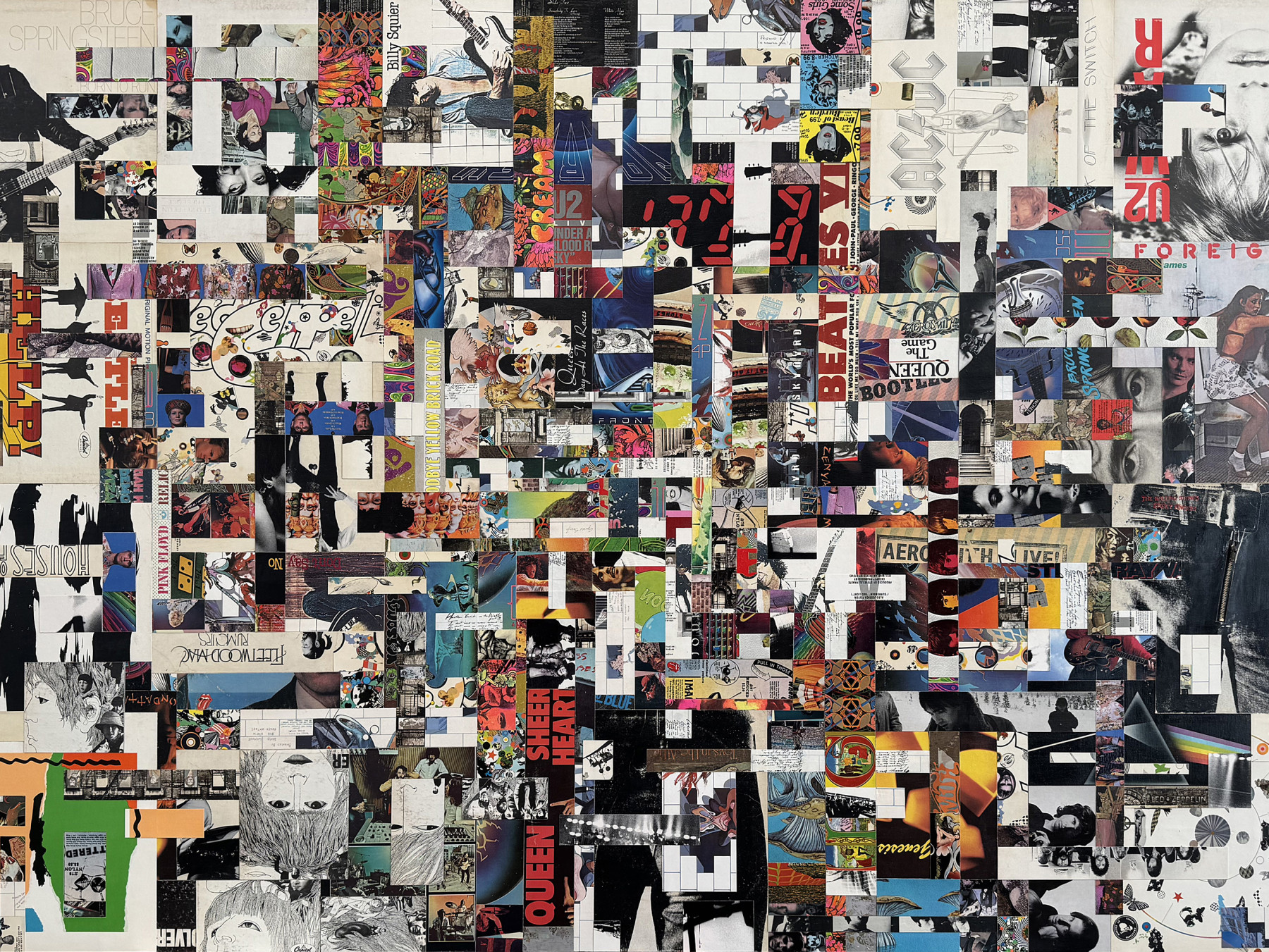
DOUG HAEUSSNER explores time, memory, and cultural residue through intricately constructed collages made from vintage rock album covers. By cutting, fragmenting, and reassembling these artifacts, he transforms them from carriers of sound into visuals of shared cultural experience. Oscillating between cohesion and disintegration, the works mirror the instability of memory where meaning is continually edited, layered, and reinterpreted. What remains is not nostalgia, but a reconfiguration of cultural energy into new visual forms.
GEORGE KOZMON’s work examines how landscapes are perceived, translated, and abstracted through systems of representation. Using digitally manipulated topographic and geological maps, he explores the distance between direct experience and mediated understanding. Referencing the idea that “the map is not the territory,” his work highlights the fluid relationship between image and reality, where scale, distortion, and abstraction reshape our connection to the natural world.
BEN STRAWN’s abstract paintings serve as portals into expansive, perceptual spaces where color, line, and form unfold across imagined horizons. Through dynamic compositions, his work explores the intersection of perception, emotion, and imagination, inviting viewers into immersive environments that transcend fixed space and time.
SABIN AELL’s process is rooted in acts of fragmentation and reconstruction - cutting, rearranging, and allowing forms to dissolve and reemerge. Working within a space of uncertainty, the work evolves through cycles of disruption and reconnection, embracing the tension between chaos and cohesion as a generative force.
GARY DAY’s practice unfolds through an ongoing exchange between traditional printmaking and digital systems. Moving fluidly between hand processes, 3D modeling, and machine learning, his work explores perception as something constructed through layered, iterative systems. Drawing from hypnopompic imagery - the visual threshold between sleep and waking - these works trace moments before recognition, where perception encounters its own formation as shifting fields of pattern, depth, and spatial awareness.